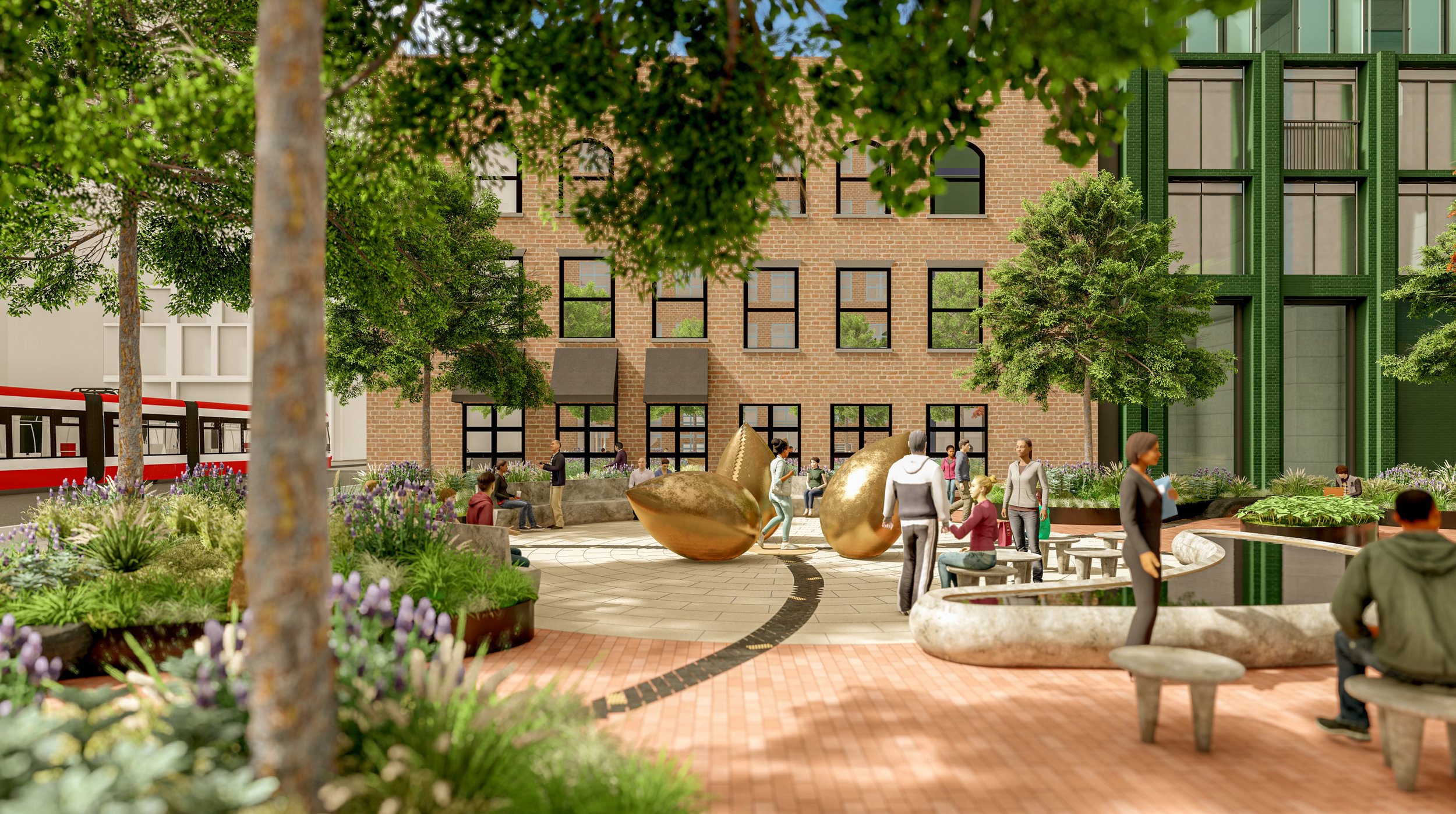

My team and I were selected by the City of Toronto to design a public park at 254 King Street East, Toronto, in collaboration with Janet Rosenberg & Studio. The successful design proposal led by Odudu Umoessien and Artist Oluseye Ogunlesi is informed by a community led vision to celebrate and commemorate the history, presence, diversity and future of black communities in the Moss park neighborhood.
The Artist Team Includes Oluseye Ogunlesi, Abel Omeiza, Ogbe David Ogbe, Ashish Ogidan, Chukwuebuka Idafum
All renderings by Odudu Umoessien, assisted by Janet Rosenberg & Studio
The new park at 254 King East is inspired by the histories of Black migration that have shaped Toronto: the forced crossings of the Transatlantic slave trade, the freedom routes of the Underground Railroad, and the ongoing arrivals, departures, and reunions of the city’s diverse Black communities.
Our goal was to translate these histories into a spatial narrative. Rather than treating the park as a container for monuments, we approached it as a journey — a place where visitors move through memory, encounter symbols, and experience migration as both a physical and emotional passage.
The design is organized around four cultural symbols: water, cowrie shells, cornrows, and Sankofa. Together, they form a landscape of movement, remembrance, orientation, and return.
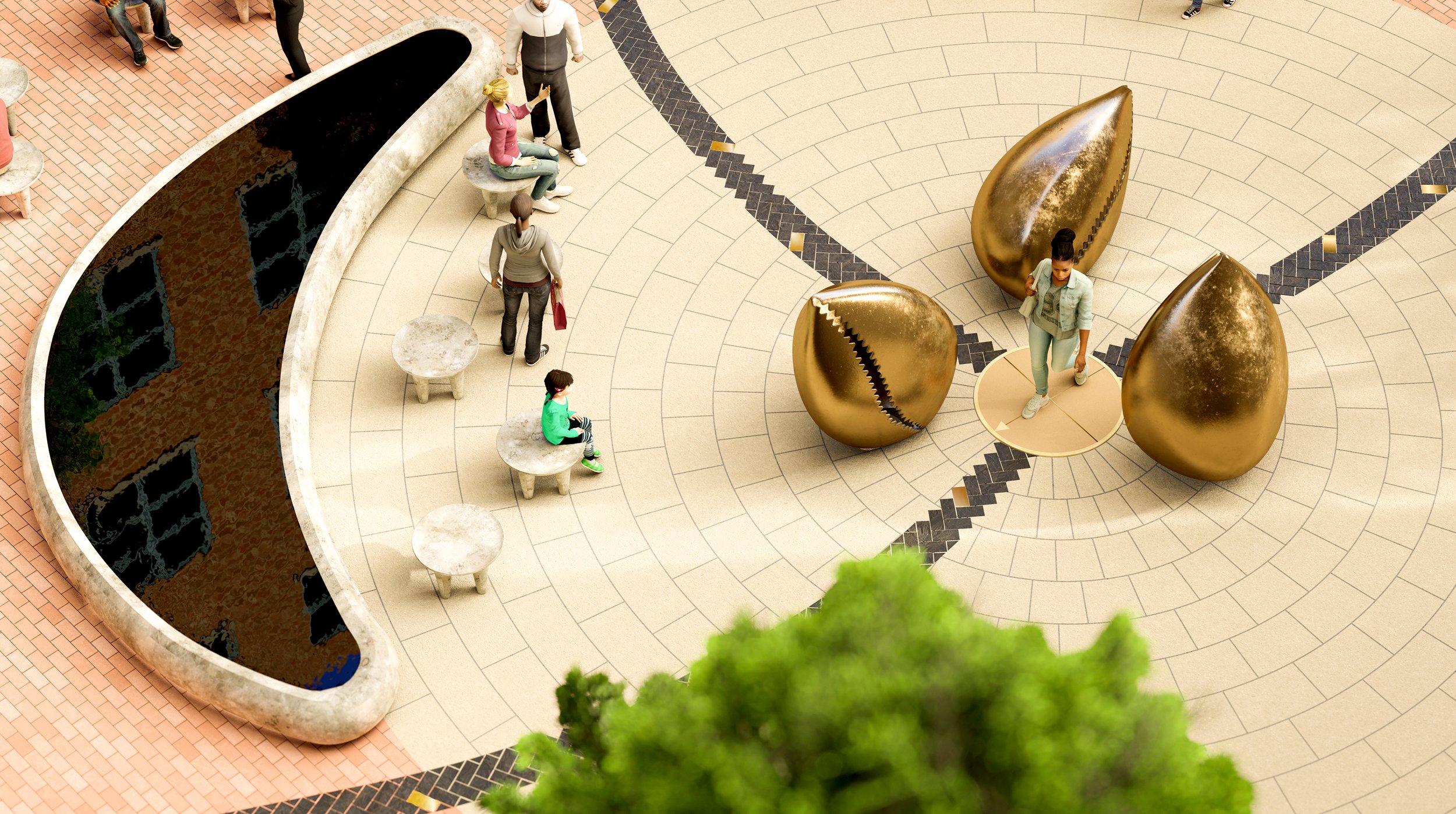
At the heart of the park, water becomes both symbol and guide. A stone water feature, inspired by the form of a West African calabash, acknowledges water as a sacred element across Black and Indigenous cultures. Water carries memory. It marks routes of displacement, survival, ceremony, nourishment, and spiritual renewal.
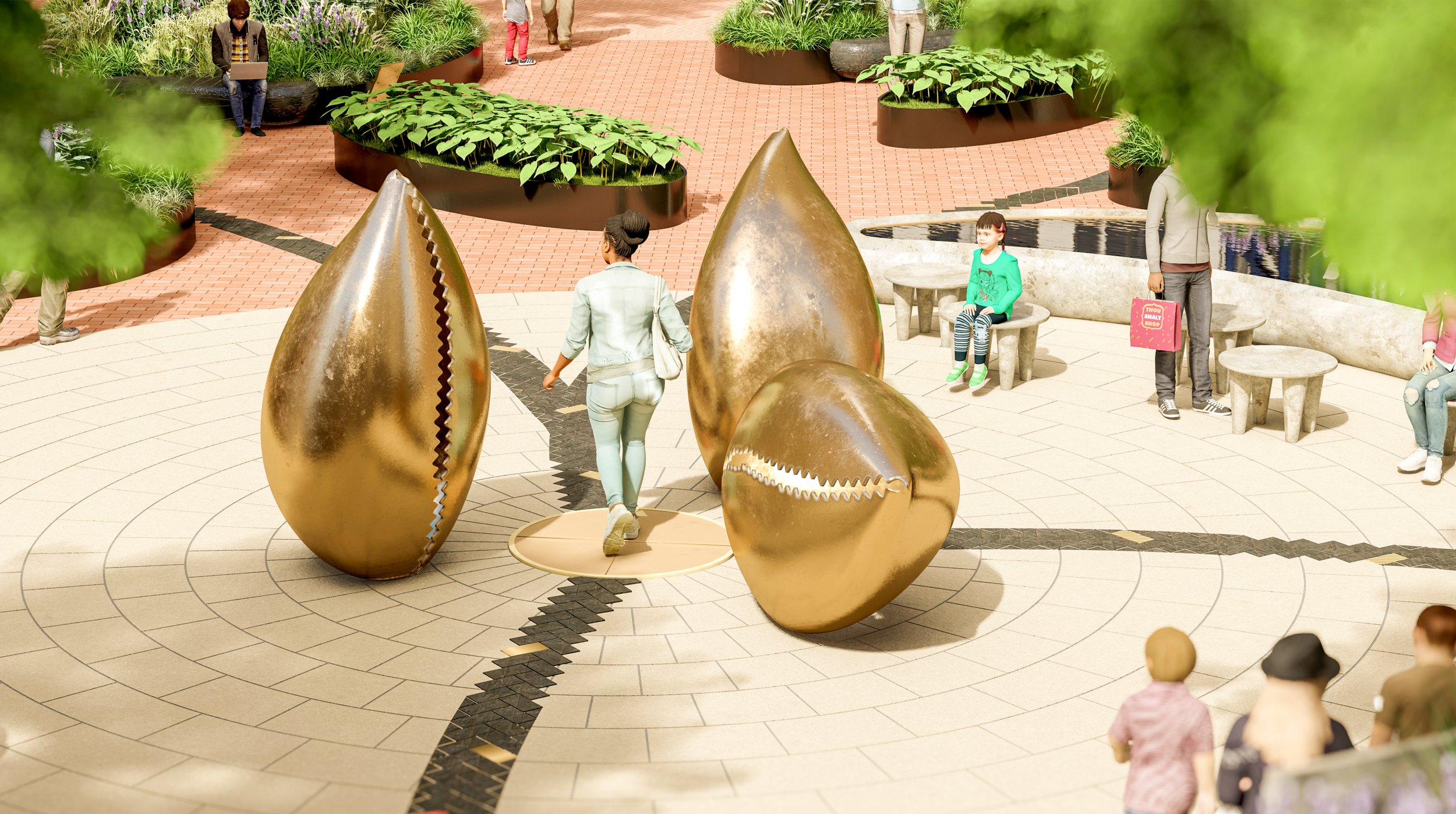
The park itself is imagined as an ocean or major waterway. At its centre sits an island of three large bronze cowrie shells, each nearly six feet tall. The cowrie is a symbol of ancestry, beauty, fertility, spirituality, wealth, and Black cultural pride. Here, the three shells represent Africa, the Americas, and the Caribbean: three geographies central to the story of Black migration to Canada.
Where the cowries meet, a compass is engraved into the ground. From this point, three braided pathways extend through the park, leading visitors toward secondary seating areas. The paths draw from the pattern and cultural meaning of cornrows — a Black tradition of beauty, identity, and, historically, coded knowledge. In this landscape, the braid becomes both pathway and map.
As visitors move along these paths, bronze inlays mark key dates in the history of Black arrival and settlement in Toronto. History is not placed on a wall at the edge of the park. It is embedded into the ground, encountered through walking, pausing, reading, and gathering.
The braided paths also echo the movement of Sankofa, the West African symbol that teaches us to look back in order to move forward. As each path reaches a seating area, it rises from the ground and becomes a circular bench. The journey becomes a place of rest. The path becomes the seat. Migration becomes arrival.
Through this project, Ikang’s methodology becomes visible: we begin with cultural memory, identify symbols with deep social meaning, and translate them into spatial experiences through movement, material, orientation, and ritual sequence. The result is a park that does not simply represent Black history, but invites people to move through it, gather within it, and understand themselves as part of a larger story.
At 254 King East, public space becomes a vessel for memory. A map of migration. A place of return.