

The Proposal as a Spatial Ritual
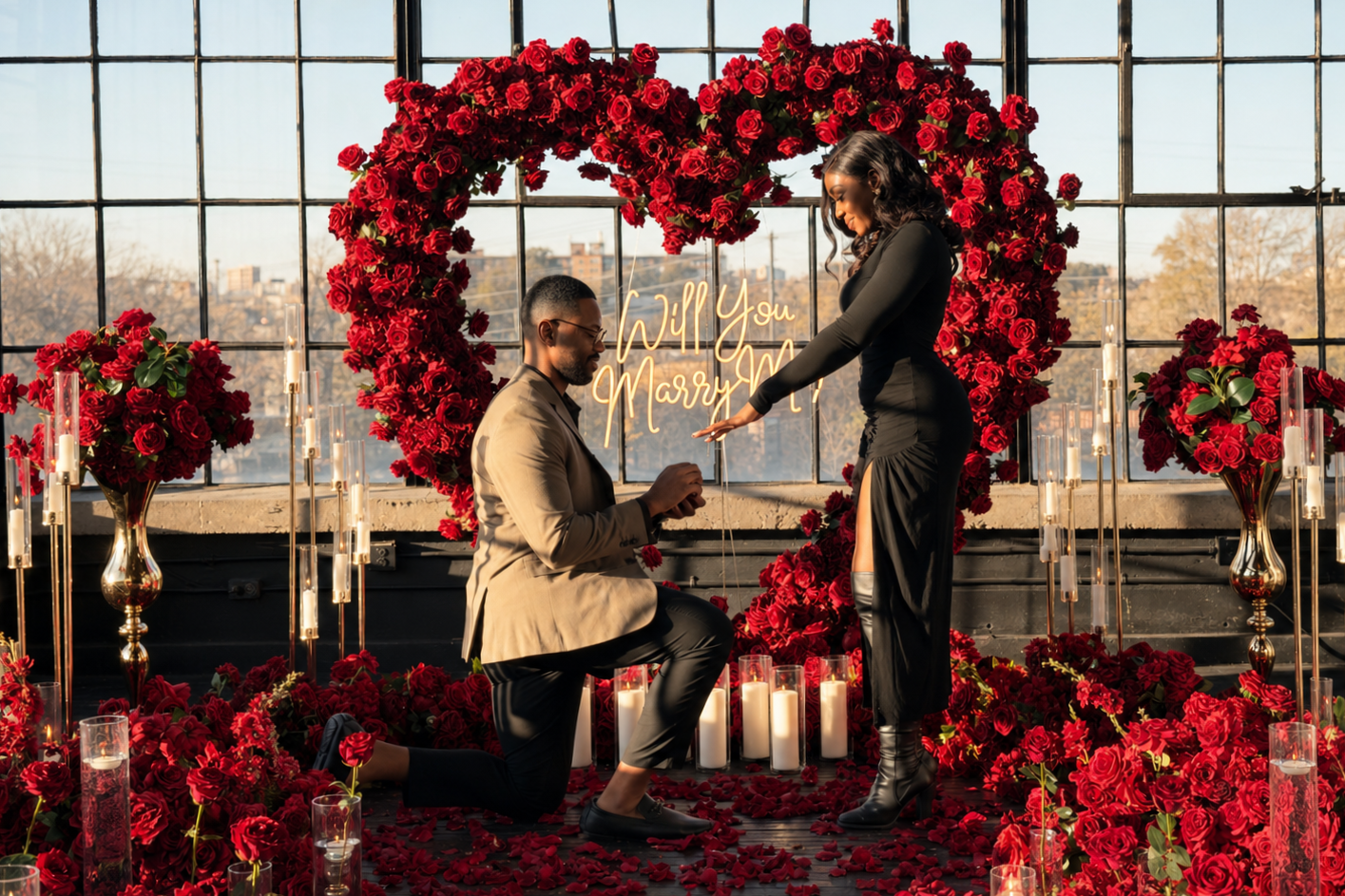
The performance of a contemporary proposal ritual
The moment of crossing
The moment she stepped onto the floral ground, my hands stopped being steady.
I had been asked to document a proposal. Usually, this is an easy role for me. I’m often the friend behind the camera, recording moments almost instinctively, holding the frame while others live inside it. But something about this moment felt different. It was not simply that I was witnessing love being made visible. It was that I could feel the moment becoming a passage from one state of relation to another.
In 2024, I witnessed a proposal for the first time. What stayed with me was the way space helped give emotion and meaning form. Through the lens of design, I began to see the proposal not simply as a romantic gesture, but as a small architecture of meaning: a sequence of movements, thresholds, gestures, and witnesses through which love became visible.
A contemporary ritual
A proposal is one of the most carefully choreographed rituals in contemporary life. Even when it appears spontaneous, it is shaped by expectations around setting, timing, emotion, bodily presence, and witness. Social research on marriage proposals suggests that they often follow a cultural script, and that accepted proposals tend to include more ritual elements than rejected ones.
This is where the proposal begins to matter for design.
It reminds us that ritual is not something distant from contemporary life, belonging only to religion, tradition, or the past. We still turn to ritual when a moment needs to carry weight. We use setting, sequence, gesture, anticipation, and witness to give shape to transformation.
The proposal makes this visible because it is both intimate and public. It belongs to two people, but rarely only to two people. It is prepared to be seen, remembered, photographed, affirmed, and retold. A private transition becomes legible through social and spatial form.
Surprise as a spatial cue
For the person being proposed to, the experience often begins with surprise. But surprise here is not only emotional. It is spatial.
The moment of not-knowing heightens awareness. The body becomes alert. Attention sharpens. A doorway, a turn, a change in ground, a gathering of familiar faces: each becomes charged before it is fully understood.
Surprise is produced through delay, concealment, framing, and reveal. Space withholds information before disclosing it. It asks the body to move before the mind has fully caught up. In that gap between not-knowing and recognition, arrival itself becomes part of the ritual.
The proposal reminds us that space does not only hold experience. It can pace experience. It can slow the body, sharpen perception, delay understanding, and prepare someone for a shift in meaning before that meaning has been spoken.
In this sense, surprise becomes a spatial tool: not a decorative effect, but a way of reorganizing awareness.
Threshold and transformation
Anthropologists have long described rites of passage as movements through separation, transition, and incorporation. Arnold van Gennep identified this structure in ritual life, while Victor Turner later developed the idea of liminality: the threshold condition in which a person is no longer fully in one state, but has not yet entered another.
That day, the threshold was literal. She moved from the warehouse onto the floral ground. But it was also symbolic. She was moving from ordinary time into ceremonial time, from not-knowing into recognition, from one condition of relation toward another.
This is what thresholds do. They do not simply divide one space from another. They prepare the body for change.
In architecture, thresholds are often treated as transitional details: doors, entries, corridors, steps, vestibules. But in ritual, the threshold is never incidental. It is where transformation begins.
The proposal made that clear. The crossing focused attention and gave the moment its ceremonial weight. It announced, without language, that the scene had shifted.
Witnessing as a design tool
I was surprised by my own body.
I was not the one being proposed to. I was not the one proposing. I was there to document. And yet, the moment affected me physically. My hands lost their stillness because I understood, without needing to be told, that I had been placed in relation to something significant.
That is what witnessing does.
To witness is not only to see. It is to become part of the social field through which an event becomes real.
Sociologist Randall Collins argues that rituals gain force through bodily co-presence, shared attention, and emotional alignment. When people gather around a common focus, the moment can generate a shared emotional charge. This is not simply an internal feeling. It is produced between bodies, through proximity, orientation, attention, and rhythm.
For spatial design, this matters deeply.
Witnessing depends on arrangement. Who stands where? Who can see? Who is invited close? Who remains at the edge? What does the space allow the witness to feel responsible for?
The witness is not passive. The witness helps hold the transformation. In a proposal, the commitment is not only spoken between two people. It is confirmed by the presence of others. It becomes socially held, emotionally intensified, and later remembered through those who saw it happen.
Witnessing, then, should be understood as a design tool. It is both social and spatial. It turns observation into relation.
What architecture might learn
Through the lens of spatial design, the proposal reveals something important about how we make meaning.
Meaning is rarely produced by a single gesture alone. It is produced through sequence: anticipation, arrival, threshold, attention, witness, declaration, response.
The proposal matters because it shows how space can make this sequence legible. It can turn movement into meaning. It can turn arrival into crossing. It can turn private emotion into something witnessed and collectively held.
This has implications far beyond the proposal itself.
Architecture often focuses on form, function, image, and permanence. But rituals remind us that meaningful space is also temporal. It unfolds. It prepares. It directs attention. It creates conditions through which people become more available to themselves and to one another.
What might architecture and public space learn from this?
That design is not only about what a space looks like, but about what it allows to happen between people. That thresholds are not simply entrances, but moments of psychological and social preparation. That public space should make room not only for circulation and use, but for witnessing, relation, and shared emotional experience.
A proposal teaches us that meaningful space is not made by form alone. It is made by the choreography of attention, movement, vulnerability, and recognition.
References
Hoplock, Lisa B., and Danu Anthony Stinson. “Rules of Engagement: A Content Analysis of Accepted and Rejected Marriage Proposals.” Journal of Family Psychology 36, no. 2 (2022): 258–267.
van Gennep, Arnold. The Rites of Passage. Chicago: University of Chicago Press, 1960.
Turner, Victor. “Liminality and Communitas.” In The Ritual Process: Structure and Anti-Structure. Chicago: Aldine, 1969.
Collins, Randall. Interaction Ritual Chains. Princeton: Princeton University Press, 2004.